



Latest News from the World of Breathalyzers
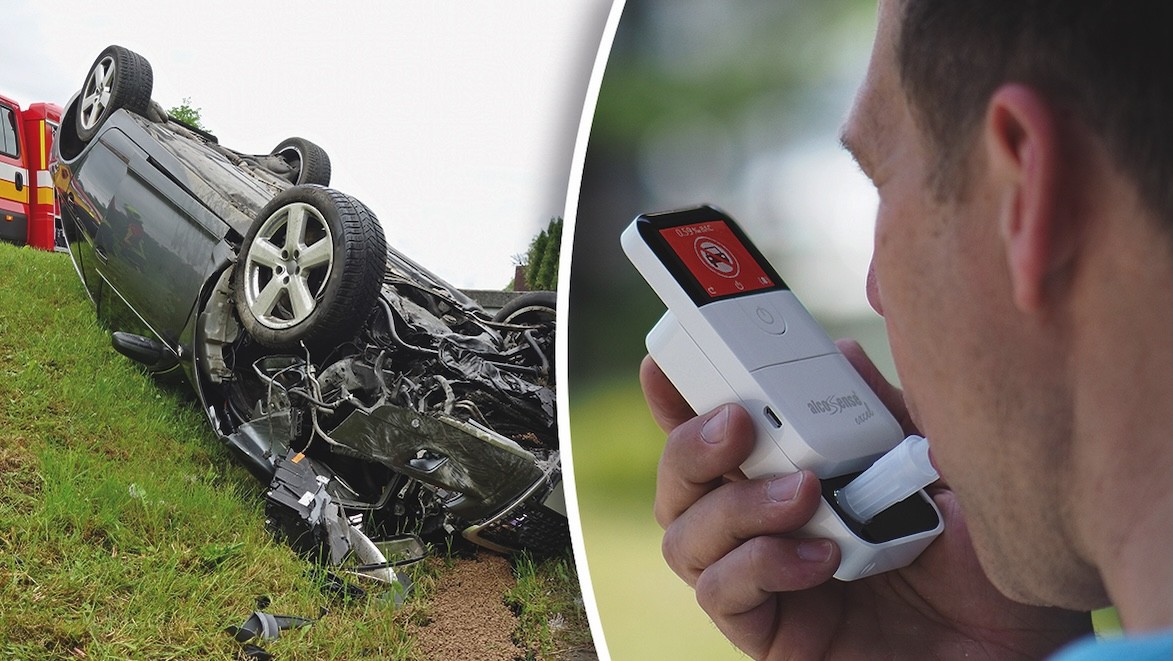
A new survey of 2,000 UK adults shows nearly eight in ten respondents (78%) said the current legal alcohol limit should be lowered from 80mg of alcohol per 100ml of blood. Just 12% said it should remain unchanged.
87% believe stricter penalties are needed to deter people from driving under the influence.
The poll by personal breathalyser firm AlcoSense is an early indication of public sentiment, ahead of the Government’s Road Safety Strategy consultation deadline of 11 May.
Nearly eight in ten respondents (78%) said the current legal alcohol limit should be lowered from 80mg of alcohol per 100ml of blood. Just 12% said it should remain unchanged.
Half of those surveyed (50%) said the limit should be slashed to 20mg or zero. A further 28% said it should be brought into line with Scotland’s 50mg limit.
There is also a clear consensus for more immediate enforcement powers. Three quarters of respondents said police should be able to suspend a driver’s licence at the roadside if they test over the limit or refuse to provide a sample.
AlcoSense managing director Hunter Abbott said the findings, which included questions similar to those in the Government consultation, indicated a shift in public attitudes.
“People are saying the current system is not tough enough,” he said. “There is staunch support not only for lowering the alcohol limit, but also for giving police the powers they need to deal with offenders quickly and effectively.
“England and Wales currently have the highest drink-drive limit in Europe. Our research suggests that many people no longer see that as acceptable.”
The call for stricter limits is even greater for higher-risk groups. Around two-thirds of respondents said commercial and novice drivers should be subject to a 20mg or zero limit.
The study suggests the public sees legal limits and police action as equally important. A majority (58%) said the most effective way to tackle drink driving would be to combine a lower limit with more robust enforcement, rather than relying on either approach alone.
“There is a clear recognition that changing the law on its own is not enough,” said Abbott, who is also a member of PACTS.
“People want to see enforcement alongside it, so that the rules have real impact.
“Motorists who pose a risk should not be allowed to continue driving while legal proceedings are ongoing,”
The latest data published by the Department for Transport show there were 260 fatalities in drink-drive accidents in 2023, with a total of 6,310 people injured in incidents involving drivers over the legal limit.
The survey findings also indicate that more stringent drink-drive laws will have limited impact on social behaviour. More than a third of those who visit pubs and restaurants said their habits would not change if the limit was reduced, while only a small minority (13%) said they would be likely to visit licensed premises less often.
Abbott added: “With the consultation closing soon, this indicates that the public expects meaningful Government action to improve road safety and prevent avoidable deaths and injuries.”
-ends-
23 April 2026
Notes:
PACTS is the Parliamentary Advisory Council for Transport Safety
AlcoSense interviewed 2,000 nationally representative UK adults via OnePoll between 24-27 March 2026. OnePoll adheres to the MRS Code of Conduct.
» read more
More than 2,700 drink-driving offences were recorded in Northern Ireland in the past year, prompting fresh warnings to motorists ahead of St Patrick’s Day celebrations.
Road safety campaigners say drivers should be particularly wary of the “morning after” effect, when alcohol from the night before can still leave them over the legal limit.
Official figures show there were 2,763 drink-driving offences recorded in Northern Ireland in the 12 months to November, highlighting that alcohol remains a significant factor in road safety incidents.
During the PSNI’s recent Christmas drink-drive enforcement campaign, officers carried out around 5,200 roadside breath tests, with more than 7% of motorists either failing the test or refusing to provide a sample.
In total, 288 people were arrested - with Belfast City once again recording the highest number of drink-drive arrests (56).
“Many people assume that if they’ve had a good night’s sleep they will automatically be safe to drive the next morning, but that’s simply not the case,” said Hunter Abbott, Managing Director of breathalyser firm AlcoSense.
“Alcohol is processed slowly by the body. Even if you feel fine the next day, you could still be over the legal limit and impaired.”
Research shows that at the legal drink-drive limit in Northern Ireland, a driver is around 13 times more likely to be involved in a fatal collision than when completely sober.
AlcoSense is urging people celebrating St Patrick’s Day to plan ahead. Options include arranging a lift home, taking a taxi or public transport, or choosing a designated driver who will not drink.
“If you’re unsure whether you’re safe to drive the next morning, the only way to know for certain is to use a personal breathalyser,” added Abbott.
“St Patrick’s Day should be about celebrating with friends and family. No one wants those celebrations to end in tragedy.”
Drivers caught over the limit in Northern Ireland can face up to six months in prison, a fine of up to £5,000 and a driving ban of at least 12 months.
» read more
Forbes tests AlcoSense Ultra: what the UK’s proposed lower drink‑drive limit means for drivers
Read Forbes' review of the AlcoSense Ultra here: https://www.forbes.com/sites/trinityfrancis/2026/0...
The UK Government has announced a consultation on lowering the drink‑drive limit in England and Wales, aiming to align it more closely with Scotland’s stricter threshold. If adopted, that would make precision even more important when deciding whether to drive — especially the morning after. [4]
In a recent article, Forbes explored this exact question. To understand how real‑life drinking translates into legality, the author used the AlcoSense Ultra across common scenarios. The takeaway was clear: with lower limits, what might feel “fine” can still put you over — and only an accurate reading tells you where you stand. [1]
The law today — and what could change
Right now, the legal limit is 35 micrograms per 100 ml of breath in England, Wales and Northern Ireland, while Scotland has been at 22 micrograms since 2014. The Government’s strategy proposes consulting on a reduction for England and Wales, which would bring consistency across the UK and place even greater emphasis on an objective reading before you drive. [2][3][4]
About units: Many consumer articles describe blood‑alcohol concentration as %BAC (e.g., 0.08%). We’re using ‰BAC here (per mille). The conversion is simple: 0.08% = 0.8‰ and 0.05% = 0.5‰. [6]
What Forbes found with AlcoSense Ultra
Forbes set up the AlcoSense Ultra and tested typical “one drink” and “two drinks” scenarios. Under the older 0.8‰ BAC conventionally associated with legacy limits, a single drink after a short interval often read under that threshold — but frequently over a lowered 0.5‰ BAC standard in line with Scotland. Two drinks pushed readings well past the proposed level. The conclusion: estimating by feel or units isn’t reliable; measurement is. [1][6]
Read Forbes' review of the AlcoSense Ultra here: https://www.forbes.com/sites/trinityfrancis/2026/0...
The morning‑after risk
The article also highlighted a common misconception — that risk only exists late at night. In reality, residual alcohol can keep you over the limit the next morning, even when you feel normal. Official guidance echoes this point: alcohol affects people differently; there’s no fixed number of drinks that guarantees legality. [1][2]
Why AlcoSense Ultra is designed for this job
To remove doubt, you need police‑grade sensing and correct sampling of deep‑lung air. AlcoSense Ultra uses the same 200 mm² professional fuel‑cell sensor technology as several UK, EU and US police breathalysers, adds pressure/flow/volume control and temperature compensation, and provides on‑screen coaching to help you perform a correct test. It also includes country‑specific limits and time‑to‑sober guidance to support conservative decisions at a glance. [5]
Forbes’ hands‑on experience mirrors this: the Ultra was simple to set up, and its readings provided practical clarity across real‑world scenarios. That aligns with our philosophy — trust a calibrated reading, not guesswork. [1]
Practical guidance for UK drivers
- Plan ahead: If you’re driving, the safest choice is not to drink. If you have drunk, don’t drive. [2]
- Treat “morning after” as high‑risk: Alcohol can remain in your system for many hours; feeling fine isn’t proof of legality. [1]
- Use a calibrated breathalyser: Choose fuel‑cell technology and maintain annual calibration for accuracy. Ultra is designed for this and provides clear retest prompts and limit awareness. [5]
- Stay informed: Follow the Government consultation and any rule changes. If England and Wales adopt Scotland’s breath limit (22 μg/100 ml), precision will matter even more. [4][3]
References & sources
- Trinity Francis, “How To Know Whether You Are Under The Drink Drive Limit Per New U.K. Rules,” Forbes, 12 January 2026 (PDF reviewed).
- Department for Transport (UK), “The drink drive limit” (current legal limits for England, Wales and Northern Ireland).
- Scottish Government / mygov.scot, “Drink‑drive limit in Scotland” (current legal limits and enforcement).
- Department for Transport (UK), Press release: “Thousands of lives to be saved under bold new Road Safety Strategy,” 7 January 2026 (includes planned consultation to lower limits).
- AlcoSense Laboratories, “AlcoSense Ultra Fuel Cell Breathalyser” (technical specifications: 200 mm² fuel‑cell sensor, deep‑lung sampling, temperature compensation, country limits, time‑to‑sober).
- “Blood alcohol content,” reference on units and conversions between percent (%BAC) and per mille (‰BAC).
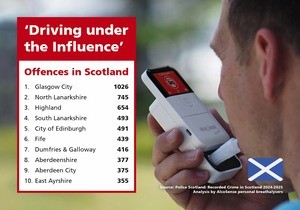
A total of 4,427 Scottish motorists were taken to court last year for ‘driving under the influence’ (DUI) according to figures published in today’s Criminal Proceedings in Scotland report.
Although this represents a decrease on the previous year, prosecutions are still up 15% compared with a decade ago - highlighting a persistent core of motorists who continue to risk lives by driving after consuming alcohol.
The number of drivers convicted was 4,260 - giving Scotland a 96% conviction rate for DUI offences.
The figures are released as Police Scotland gets underway with its annual Christmas and Hogmanay drink and drug drive campaign, which runs until 2 January 2026. Drivers can expect an increase in roadside breath testing, with targeted patrols in known drink-drive hotspots such as Glasgow, North Lanarkshire, the Highlands, South Lanarkshire and Edinburgh.
Last Christmas, officers carried out 4,779 breath tests and 963 roadside drug wipes, resulting in over 1,300 offences detected - the highest activity levels seen in recent years.
In 2023, ten people were killed by a drink driver and 300 were injured, according to Transport Scotland. While a reduction on the previous year, the toll remains “unacceptably high”, says Hunter Abbott, Managing Director of personal breathalyser firm AlcoSense.
“It only takes one impaired driver to devastate families,” comments Abbott. “With Scotland’s lower drink drive limit, even small amounts of alcohol can put you over the legal threshold.”
“The only reliable way to know you’re safe and legal to drive is to self-test with a personal breathalyser. Particularly the morning after a night out, when alcohol can remain in your system for many hours.”
Abbott warns that December is the highest-risk month for both collisions and enforcement.
“Police Scotland ramp up roadside checks over Christmas and Hogmanay. If you’ve been drinking, your chances of being breathalysed are significantly higher than at other times of year.”
- ends –
9 December 2025
Sources:
Scottish Government: Criminal Proceedings in Scotland 2023–2024
Transport Scotland: Reported Road Casualties Scotland 2024
Police Scotland Festive Drink & Drug Driving Campaign Statistics